
If you’re into health, you probably have a “pharmacy shelf” at home.
Magnesium for sleep. Omega-3 for the heart. Vitamin D because “everyone is deficient”. Theanine to calm down.
Each bottle is “only” $10–$20. No big deal, right? That’s what I thought.
Then one day I decided to answer a simple question:
How much does my supplement routine cost me per year?
Not “per bottle”. Not “around this much”. I wanted a number.
I grabbed a notebook, a calculator and a few bottles. Twenty minutes later, I was slightly pissed.
The myth of “cheap” supplements
Let’s use a simple example: L-theanine.
You search for “theanine 60 capsules” and see a wall of almost identical bottles. Same ingredient, similar doses, similar prices.
On the surface:
- Bottle A — $11.99
- Bottle B — $13.50
- Bottle C — $9.99
- Bottle D — $17.40
Most people pick a brand they recognize, or something “in the middle”, and feel rational.
The problem: the bottle price is the least interesting number on the page.
Because:
- One brand calls 1 capsule a serving, another calls 2 capsules a serving.
- Your personal dose might not match the label.
- You don’t always take it daily.
So the real question is not,
How much is this bottle?
The real question is:
How much does my dose cost per day — and per year?

Same ingredient. Same dose. 73% price difference.
Say you take 200 mg of theanine per day.
- Bottle A: 100 mg per capsule, 60 capsules, $11.99
- Bottle B: 200 mg per capsule, 60 capsules, $13.50
Looks similar, right?
For your dose:
- Bottle A → 2 capsules/day
- Bottle B → 1 capsule/day
1. How many days does one bottle last?
- A: 60 ÷ 2 = 30 days
- B: 60 ÷ 1 = 60 days
2. Cost per day
- A: 11.99 ÷ 30 ≈ $0.40/day
- B: 13.50 ÷ 60 = $0.23/day
3. Cost per year
– A: 0.40 × 365 ≈ $146/year
— B: 0.23 × 365 ≈ $84/year
Same active ingredient. Same daily dose. Different bottle.
One option quietly costs ~$146/year, the other ~$84/year. That’s a 73% difference for the same result.
And this is still the small story.
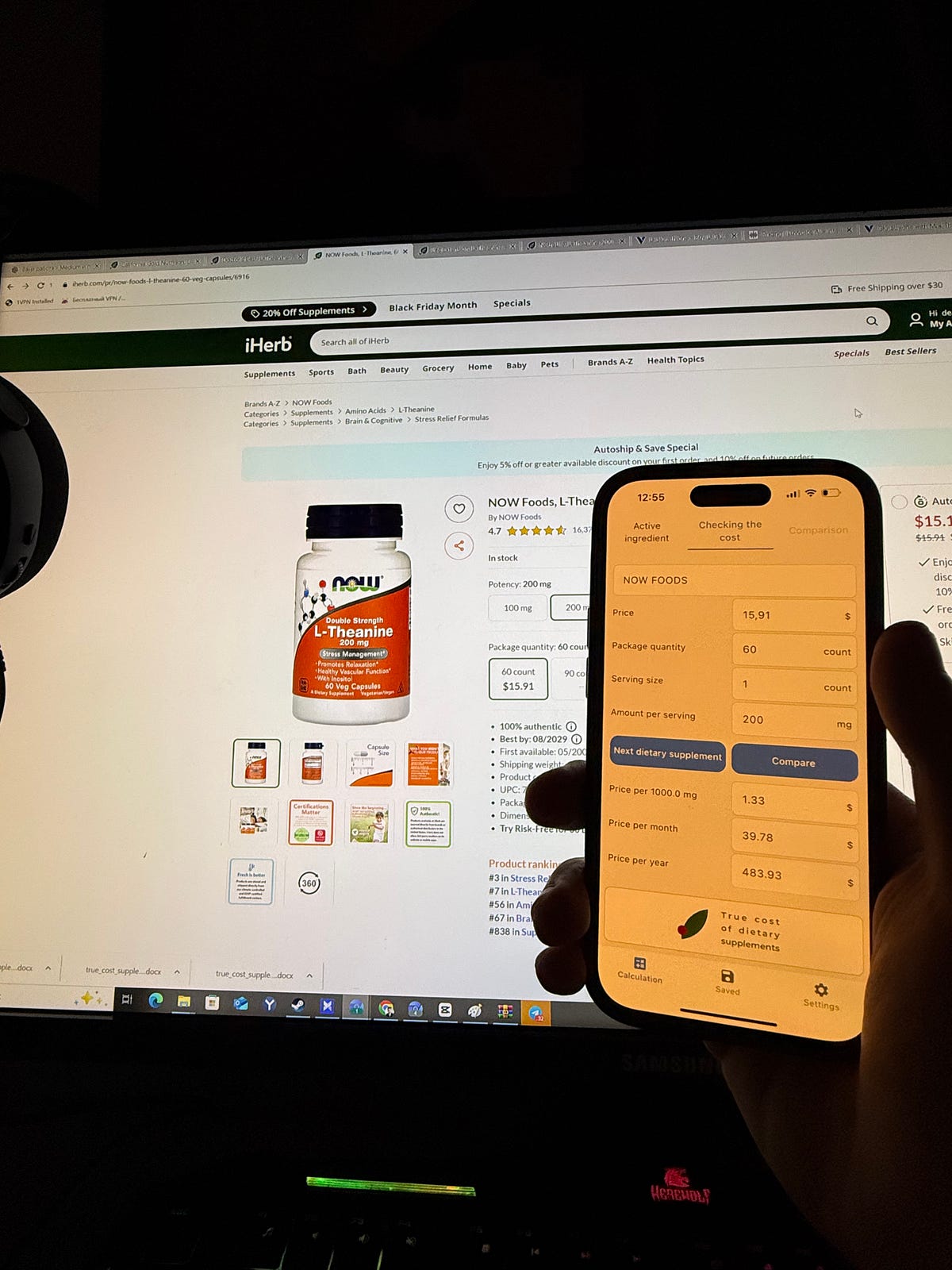
When the gap jumps from $60… to over $800 per year
Here’s what happens when you compare several brands by the same daily dose of theanine and actually normalize everything to “price per 1000 mg” and then “per month / per year”.
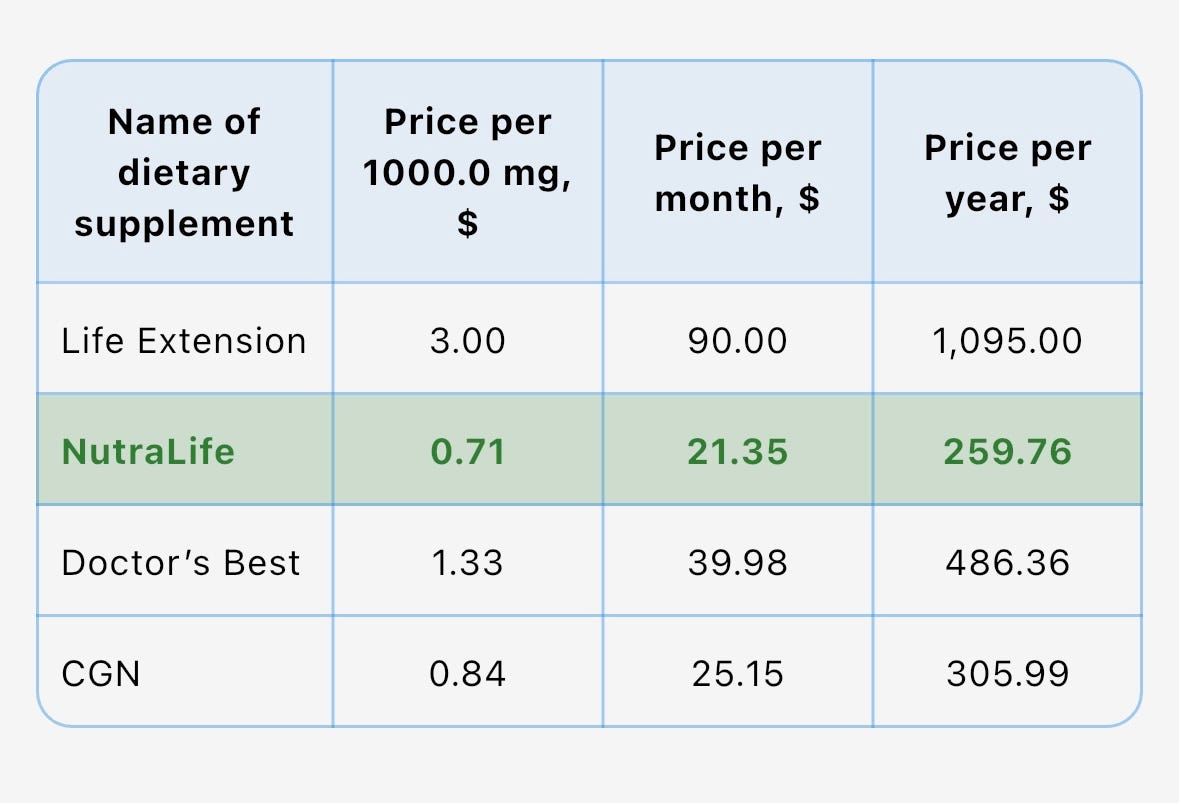
Same ingredient. Same 1000 mg/day. Four different brands.
- Life Extension — about $3.00 per 1000 mg, ~$90/month, or $1,095/year.
- NutraLife — about $0.71 per 1000 mg, ~$21.35/month, or $259.76/year.
- The other brands sit somewhere in between.
So for the same daily intake:
- Cheap option: $259.76/year
- Expensive option: $1,095/year
That’s a gap of
$835 per year difference for the same molecule.
Over 3 years, that’s $2,500+.
Over 5 years, more than $4,000.
That’s not “I saved sixty bucks”.
That’s a vacation, a new laptop, or a lot of lab tests you could have paid for instead of overpaying for the exact same theanine.
And again — this is just one supplement.

Why almost nobody knows their real supplement budget
When I started checking my own stack, I realized most people are blind here for three simple reasons:
- Labels speak a different language. “Serving size 3 softgels”, “take 1 capsule 1–3 times daily” — that’s not how the brain thinks about money.
- Stores sell bottles, not outcomes. You see “$14.99 per bottle”, not “$412/year for your actual intake”.
- Life isn’t clean. You change doses, skip days, add and remove products. Great for your flexibility. Terrible for mental math.
So you keep adding “just one more bottle”. Ten bottles later you’re running a quiet, untracked, three- or four-figure annual expense.
How this turned into a spreadsheet… then into an app
My first move was the nerdy one:
I’ll just build a spreadsheet. How hard can it be?
I made a table and entered: name and brand, price per bottle, capsules per bottle, mg per capsule, my actual dose and frequency.
The spreadsheet gave me cost per personal serving, cost per day, cost per month, cost per year.
The result? A few products were clearly worth it. A few were “whatever”. And a few were basically lighting money on fire.
Friends saw the spreadsheet and said
Send it to me, I want to check my stack
Then more friends asked. Then someone said the line that changed it:
I hate spreadsheets. Just make an app.
So I did.
I built a small iOS app called “True Cost of Dietary Supplements”.
You enter what’s on the bottle and how you actually use it. The app shows
- cost of your dose per day, month, year,
- and lets you compare bottles side by side.
Instead of doing 5 lines of math every time, you just see:
- Option A — $0.40/day → $146/year
- Option B — $0.23/day → $84/year
- Or, in heavier cases, $259/year vs. $1,095/year for the same daily dose.
Now the decision is obvious.
But here’s the important part: You don’t need my app to benefit from this article. You just need one simple formula.
The 10-second formula
This is the whole game:
Cost per day = (Price per bottle) ÷ (Number of days one bottle lasts for your prescribed dose)
How to get there:
- Figure out how many capsules you take per day.
- Divide total capsules in the bottle by that number → days per bottle.
- Divide price by days per bottle → cost per day.
- Multiply by 365 → cost per year.
Do this for a few products and you’ll never look at bottles the same way again.
Run a 20-minute audit on your stack
Block 20 minutes. Grab your bottles.
Step 1. Pick 3–5 supplements you actually use.
Step 2. For each one, write
- price you paid
- capsules/grams per package
- how much you really take and how often.
Step 3. Calculate
- days per bottle
- cost per day
- cost per year
Step 4. Ask yourself
- Which product quietly eats the biggest part of my budget?
- What do I barely feel the effect from?
- If I had to cut my supplement spending by 30–50%, what would go first?
You’ll see three kinds of products:
- No-brainers — cheap and clearly helpful. Keep them.
- Luxury items — expensive but you truly value them. Consciously choose them.
- Dead weight — high cost, low impact. These are your “hidden tax”.
Cutting just the dead weight can save you hundreds or even thousands over a few years with zero downside.
This isn’t about quitting supplements
I’m not a doctor, and this is not medical advice. I’m not saying “stop taking supplements”.
What I am saying is
If you’re going to invest in your health long term, at least know the bill
Supplements sit in a strange space: not quite medicine, not quite food. Each bottle is cheap enough that we don’t think twice. But together, over years, they behave exactly like a subscription.
A silent one.
If you find out your routine costs $600, $900 or more per year instead of the $150 you had in mind, you suddenly have an option
- Keep everything and accept the real price
- Cut a few things and redirect that money into labs, better food, or training
- Optimize brands and doses and keep the results while paying way less
All three are valid. The only “bad” scenario is not knowing.
A tiny challenge for this week
This week, take one supplement you use all the time.
- Compare 3–4 brands by yearly cost of your dose, not bottle price.
- Look at the spread.
- Decide if the extra cost is worth it — consciously.
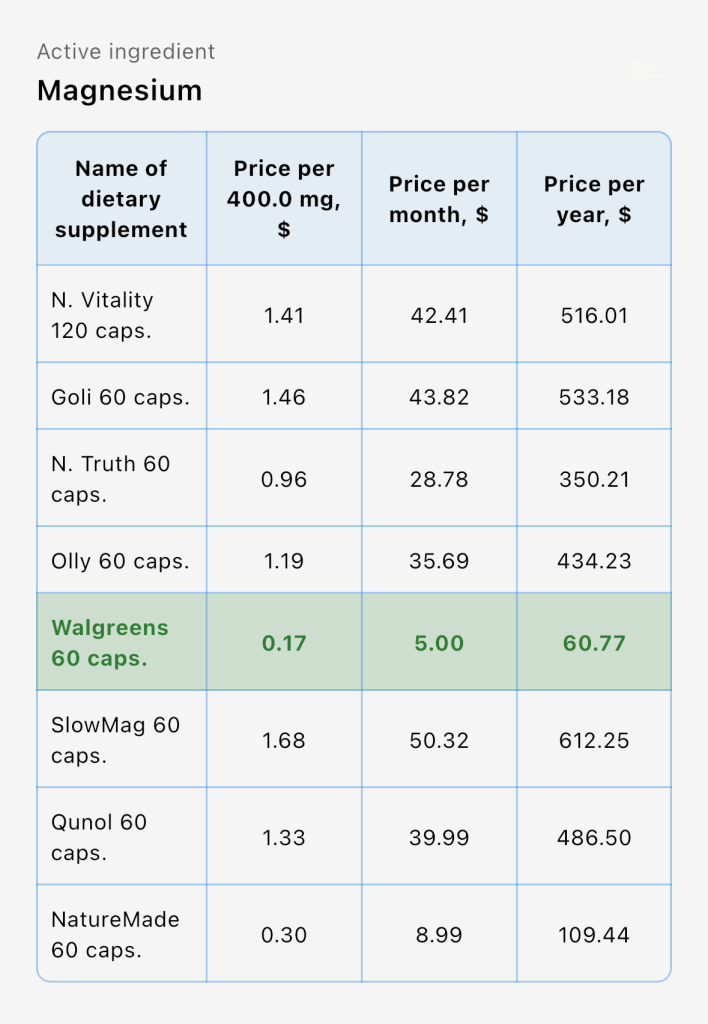
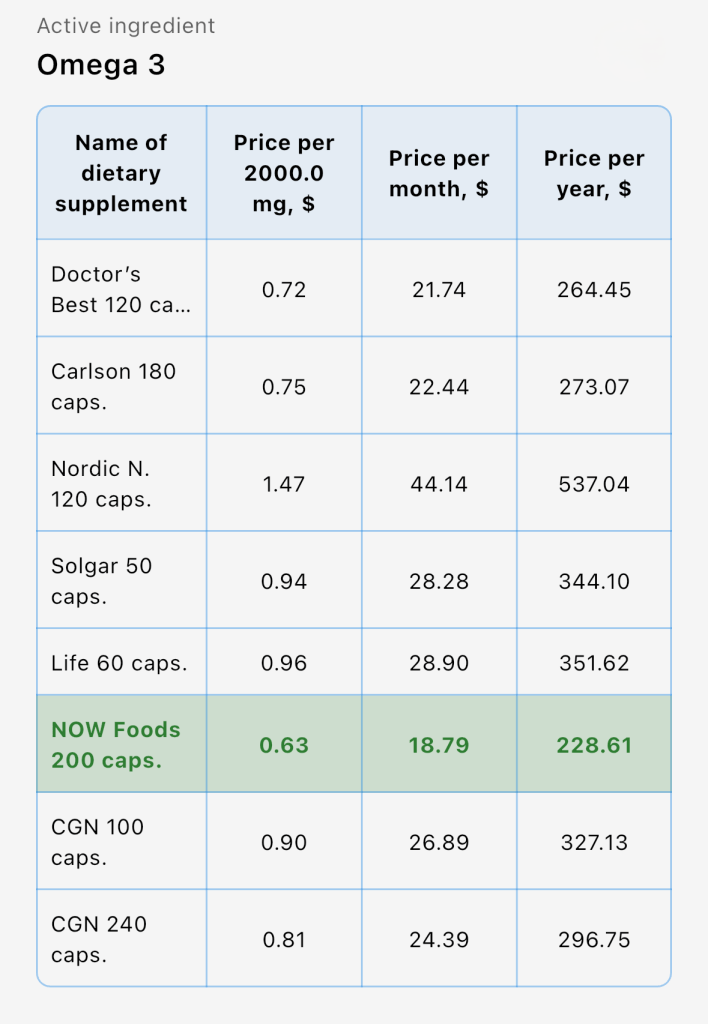
In future articles, I’ll break down and compare specific categories of supplements — for example different types of magnesium, omega‑3s, sleep stacks, nootropics and more.
If you want me to start with a particular group, tell me in the comments which supplements (or brands) you’re most curious about in terms of their real yearly cost.
If you want help with the math, you can try my app “True Cost of Dietary Supplements” on the App Store — that’s exactly why I built it.
But even if you never touch the app, I want you to walk away with one question burned into your brain:
How much does my dose cost me per year?
Ask that once, run the numbers, and your “pharmacy shelf” stops being a mystery expense and finally becomes a conscious investment.
Compare any supplements from different stores
Contact
Your message has been sent


Designed by Ivan

 True cost of dietary supplements